Restoring Sight: Therapeutic Perspectives in Wolfram disease – Virtual Global Research and Trial Updates
Overview
Dr. Cécile Delettre-Criballet presented on therapeutic perspectives for Wolfram disease at a global virtual conference. Her team at the Institute for Neuroscience of Montpellier focuses on hereditary optic neuropathies and anterior segment diseases. They use genetic diagnostics, pathophysiological studies, and clinical trials to develop treatments. Key findings include the effectiveness of gene therapy in mouse models, showing improved visual acuity and reduced axonal damage. They also explored pharmacological approaches using synthetic polyamines, which enhanced retinal ganglion cell growth in zebrafish models. The discussion highlighted the potential of these therapies to address Wolfram syndrome’s optic atrophy and other symptoms.
Action Items
- Observe the effects of systemic gene therapy using the WFS1 gene on retinal ganglion cells and optic nerve structure in the severe Wolfram syndrome mouse model.
- Test the effects of the synthetic polyamine compound SPA on protecting against optic nerve atrophy in the zebrafish model of optic neuropathy.
Outline
Introduction to the Institute for Neuroscience of Montpellier

- Cécile Delettre-Criballet thanks the organizers and introduces her team at the Institute for Neuroscience of Montpellier.
- She explains the institute’s focus on neuroscience, with eight teams working on various scientific areas.
- Cécile Delettre-Criballet describes her group’s expertise in hereditary optic neuropathies and anterior segment diseases.
- She highlights the close collaboration with clinicians from various departments, including ophthalmology, genetics, neurology, and technology.
Research Strategy and Clinical Trials

- Cécile Delettre-Criballet outlines the research strategy, starting with patient recruitment and clinical trials.
- She mentions ongoing clinical trials, including the use of sodium valproate for Wolfram syndrome and artificial cornea transplants for corneal blindness.
- Cécile Delettre-Criballet provides a brief overview of Wolfram syndrome, its symptoms, and the role of the WFS1 gene.
- She emphasizes the importance of understanding optic atrophy and its impact on vision.
Optic Atrophy and Genetic Diagnostic Approaches

- Cécile Delettre-Criballet explains the causes of optic atrophy and its impact on vision, using visual examples.
- She discusses the prevalence of WFS1 gene mutations in inherited optic neuropathies and their clinical presentations.
- Cécile Delettre-Criballet describes the role of mitochondria in energy production and its relevance to optic atrophy.
- She outlines the challenges of treating optic neuropathies, including crossing the blood-retinal barrier and assessing therapeutic efficacy.
Gene Therapy and Pharmacological Approaches

- Cécile Delettre-Criballet introduces gene therapy as a promising approach for optic nerve protection.
- She describes a clinical trial using gene therapy in Leber optic atrophy, showing significant improvements in visual function and retinal anatomy.
- Cécile Delettre-Criballet explains the use of mouse models to study optic atrophy and the effectiveness of gene therapy.
- She discusses the challenges of treating severe Wolfram syndrome models and the potential of systemic gene therapy.
Pharmacological Approaches and Collaborative Research

- Cécile Delettre-Criballet introduces pharmacological approaches, focusing on the role of polyamines in retinal ganglion cell survival.
- She describes a collaboration with chemists to develop synthetic polyamines and their effectiveness in promoting neurite growth.
- Cécile Delettre-Criballet presents data showing the effectiveness of synthetic polyamines in treating optic neuropathy models.
- She discusses ongoing research using zebrafish models to test the effectiveness of synthetic polyamines in protecting the optic nerve.
Conclusion and Acknowledgements
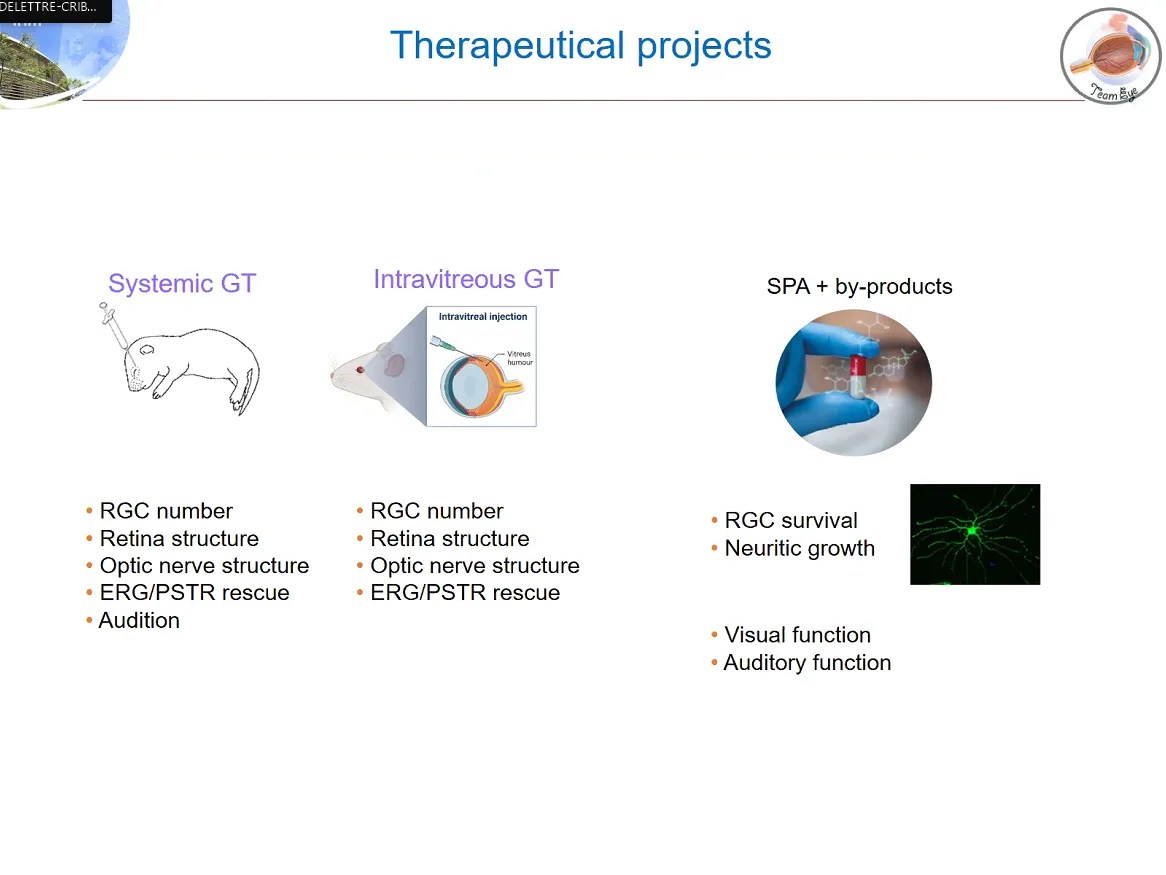
- Cécile Delettre-Criballet summarizes the therapeutic projects, emphasizing the use of gene therapy and pharmacological therapy.
- She mentions the potential of systemic gene therapy in severe Wolfram syndrome models and the use of synthetic polyamines.
- Cécile Delettre-Criballet thanks the team, families, and associations for their support.
- Wolfram Syndrome UK opens the floor for questions, with Dr. Arano asking about the improvement in vision following PBS injections.
- Cécile Delettre-Criballet explains the observed effects of PBS injections and the potential activation of growth factors.